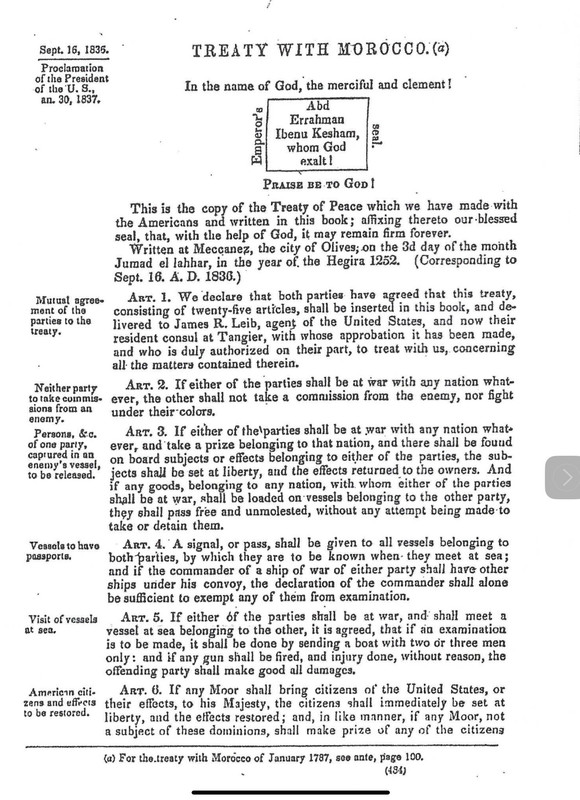
📜 Additional Legal Principles Strengthening the Grant
- Sharia Law: Signed by the Emperor of Morocco, the treaty is binding under both international and Islamic legal traditions – sacred and irrevocable.
- Trust Law Principles: The United States holds the rights granted by the Emperor in trust for the beneficiaries (you). The trustee cannot modify the trust without beneficiary consent.
- Legal Maxim: "A grant is to be construed in favor of the grantee" – any ambiguity in the treaty is resolved in your favor.
- Kingdom of Morocco Clarification: The 1836 Treaty was signed by the Emperor of Morocco, not the modern Kingdom. The grant is from the sovereign – it survives changes in government and cannot be unilaterally revoked.
⚠️ Domestic Courts Are Excluded
Under Article 21 of the 1836 Treaty, disputes between treaty parties are resolved by consuls, not domestic courts. The only exceptions are personal acts (killing/wounding, contraband). You cannot waive this right – it is a sovereign jurisdictional bar. Even if a party wanted to go into domestic court, the treaty forbids it.
"A signal, or pass, shall be given to all vessels belonging to both parties..."
In 1836 maritime law, this was not a suggestion – it was a juridical command from the Emperor. Today, your Article 4 Signal is a sovereign grant of authority that exempts your cargo from search, detention, or delay without cause. Your cargo moves under sovereign protection, not bureaucratic whim.
"If the commander of a ship of war... shall have other ships under his convoy, the declaration of the commander shall alone be sufficient to exempt any of them from examination." — Article 4
Your Signal is issued upon onboarding. It is vested. It does not expire.
🚢 No Port Detention
"No vessel shall be detained in port on any pretence whatever, nor be obliged to take on board any article without the consent of the commander."
Vested right: Absolute prohibition on detention. Eliminates dwell time, demurrage, and forced loading – saving millions in buffer days.
"All goods shall be weighed and examined before they are sent on board; and to avoid all detention of vessels, no examination shall afterwards be made, unless it shall first be proved that contraband goods have been sent on board."
Vested right: Single inspection at origin – no surprise post-loading exams.
"If any vessel of the United States shall be forced to put into our ports by stress of weather, or otherwise, she shall not be compelled to land her cargo, but shall remain in tranquillity until the commander shall think proper to proceed."
Vested right: Safe harbor without forced discharge.
🛍️ Uncompelled Commerce
"Merchants shall not be compelled to buy or sell any kind of goods but such as they shall think proper."
Vested right: No forced localization, no mandatory procurement – full freedom of contract.
"Merchants of both countries shall employ only such interpreters... as they shall think proper... and all persons employed... shall be paid at their customary rates, not more and not less."
Vested right: Choose your own agents; no forced labor; fair, predictable wage costs.
"The commerce with the United States shall be on the same footing as is the commerce with Spain, or as that with the most favored nation for the time being."
Vested right: You automatically receive the best trade terms granted to any nation – updated in real time. Examples from the last decade:
- USMCA (2020) – Zero tariffs on most goods between U.S., Mexico, and Canada
- U.S.-Japan Trade Agreement (2020) – Reduced tariffs on $7.2B in agricultural and industrial goods
- U.S.-EU Limited Tariff Agreement (2021) – Lowered tariffs on $2B in cross-Atlantic trade
- U.S.-Kenya Strategic Trade Partnership (2022) – Preferential access for African apparel and agricultural products
- Indo-Pacific Economic Framework (2023-2026) – Emerging trade preferences with 14 Asia-Pacific nations
- U.S.-Vietnam Comprehensive Partnership (2025) – Expanded duty-free access for electronics, textiles, and agricultural goods
Under Article 14, every one of these advantages extends to treaty‑protected commerce – automatically, without renegotiation.
⚡ What This Means for You
Every time the U.S. negotiates a better trade deal with any nation – lower tariffs, expedited customs, preferential access – your treaty‑protected commerce gets that same advantage immediately. You don't wait. You don't lobby. You don't renegotiate.
The question isn't whether you can afford to activate treaty protection. The question is: can you afford to leave $149M on the table?
🚀 Activate Your Treaty Rights Today⚖️ Consular Jurisdiction
"If any of the citizens of the United States... shall have any dispute with each other, the consul shall decide between the parties; and whenever the consul shall require any aid... to enforce his decisions, it shall be immediately granted."
Vested right: All disputes between treaty parties resolved exclusively by consuls – not foreign courts.
"If a citizen of the United States should kill or wound a Moor... the law of the country shall take place, and equal justice shall be rendered, the consul assisting at the trial."
Vested right: Domestic courts excluded for disputes between parties; only personal acts (killing/wounding, contraband) fall outside consular venue.
"If an American citizen shall die in our country... the consul shall take possession of his effects... and if the heir... be present, the property shall be delivered to him without interruption."
Vested right: Immediate protection of assets; no escheatment or local confiscation.
"The consul of the United States of America, shall reside in any seaport of our dominions that they shall think proper: and they shall be respected, and enjoy all the privileges which the consuls of any other nation enjoy."
Vested right: Full diplomatic privileges for the Consul – unimpeded representation.
🌟 Indulgences & MFN
"... whatever indulgence, in trade or otherwise, shall be granted to any of the Christian Powers, the citizens of the United States shall be equally entitled to them."
Vested right: Any trade advantage given to any other nation automatically applies to you. You never need to negotiate separately.
🛡️ War & Crisis Provisions
"If either of the parties shall be at war with any nation whatever, the other shall not take a commission from the enemy, nor fight under their colors."
Vested right: Guaranteed neutrality – your ships won't be conscripted or targeted.
"If goods belonging to any nation with whom either party shall be at war shall be loaded on vessels belonging to the other party, they shall pass free and unmolested."
Vested right: Cargo immunity even if your customer is at war with a third party.
"If any Moor shall bring citizens of the United States, or their effects, to his Majesty, the citizens shall immediately be set at liberty, and the effects restored."
Vested right: Immediate recovery of kidnapped personnel or seized goods.
"If we shall be at war with any Christian Power... no vessel belonging to the enemy shall follow, until twenty-four hours after the departure of our vessels."
Vested right: Head start for your vessels in conflict zones.
"In case of a war between the parties, the prisoners are not to be made slaves, but to be exchanged... one hundred Mexican dollars for each person wanting."
Vested right: Humane treatment and guaranteed ransom terms – no indefinite detention.
"If a war shall break out between the parties, nine months shall be granted to all the subjects of both parties, to dispose of their effects and retire with their property."
Vested right: If relations break down, 9 months to wind down without loss – unheard of in modern sanctions.
⏳ Eternal Duration
"This treaty shall continue in force, with the help of God, for fifty years; after the expiration of which term, the treaty shall continue to be binding on both parties, until the one shall give twelve months' notice to the other, of an intention to abandon it."
Vested right: No expiration, no renegotiation. Since 1836, neither party has given notice. It remains active – providing stability that no modern trade agreement can match.
⚓ Additional Maritime Protections
"A signal, or pass, shall be given to all vessels belonging to both parties... and if the commander of a ship of war of either party shall have other ships under his convoy, the declaration of the commander shall alone be sufficient to exempt any of them from examination."
Vested right: Convoy protection – entire fleets move without individual inspection.
"If an examination is to be made, it shall be done by sending a boat with two or three men only: and if any gun shall be fired, and injury done, without reason, the offending party shall make good all damages."
Vested right: Minimal-force inspections with full liability for wrongful damage.
"If any vessel of either party, shall put into a port of the other, and have occasion for provisions or other supplies, they shall be furnished without any interruption or molestation."
Vested right: Guaranteed access to supplies in foreign ports.
"If any vessel of the United States, shall meet with a disaster at sea, and put into one of our ports to repair, she shall be at liberty to land and reload her cargo, without paying any duty whatever."
Vested right: Duty-free temporary landing for repairs – major cost savings.
"If any vessel of either of the parties shall have an engagement with a vessel belonging to any of the Christian Powers, within gun-shot of the forts of the other, the vessel so engaged, shall be defended and protected as much as possible."
Vested right: Active military protection if attacked near treaty partner's shores.
"If any ship of war belonging to the United States, shall put into any of our ports, she shall not be examined on any pretence whatever, even though she should have fugitive slaves on board."
Vested right: Warship immunity – no inspection, no interference, even with sensitive cargo.
"If a ship of war of either party shall put into a port of the other, and salute, it shall be returned from the fort with an equal number of guns, not more or less."
Vested right: Full diplomatic honors – respect and reciprocity.
The 1836 Treaty grants full consular jurisdiction to U.S. and Moroccan citizens. For trading partners, we offer structured access to this sovereign framework.
- ✅ Direct liaison with U.S. or Moroccan consul for dispute facilitation
- ✅ Treaty-based advocacy in port detentions or inspections
- ✅ Access to Article 4 "Signal" documentation for your shipments
- ✅ Everything in Tier 1
- ✅ Consular representation in local legal proceedings
- ✅ Expedited dispute resolution under Article 20 protocols
- ✅ Sovereign immunity advocacy for cargo and vessels
- ✅ Everything in Tier 2
- ✅ Designated consul liaison for your enterprise
- ✅ Full consular jurisdiction opt-in (disputes handled under treaty, not local courts)
- ✅ Sovereign-level protection for all shipments and personnel
* Tier 3 requires formal onboarding and agreement. Contact us to discuss your specific needs.
When treaty protections eliminate delay variance, you safely reduce buffer days and release trapped working capital.
Customer retains 15% of all verified savings.
Automate release/hold evidence for origin traceability.
Sync agency sequencing to prevent silent blocks.
Control coordination exceptions during screening.
Suppress dwell variance via measurable thresholds.
Enforce compliance and cash recovery workflows.
Map & Analyze
We audit your trade lanes and surface data to pinpoint exactly where delay and cost originate.
Activate
We issue your Article 4 Signal and serve alignment notices on relevant agencies.
Verify & Scale
We deliver a baseline report proving reduction and cash impact. You keep 15% of verified savings.